Cars are dangerous. A tonne and a half of metal and glass moving at 70mph is one of those examples of humanity’s fundamental hubris that makes you wonder how we’ve managed to make it this far without all ending up in some horribly fiery accident. And yet, nine times out of ten, whenever a car is involved in an accident, the car itself isn’t to blame. Whether it’s not been maintained correctly, or is being driven without due care and attention, the most dangerous part of a car is usually the slab of meat behind the wheel. That being said, there are some cars that were dangerous right from the moment they rolled off the forecourt. Here’s five of them:

In late January 2015, Autocar were running their usual suite of tests on the brand-spanking-new Suzuki Celerio. Now, Autocar’s tests are well-worn and time honoured, conducted on everything from a Volkswagen Up to a Bugatti Veyron, so there was no inkling that anything would go badly, that was until they got to the 80mph emergency stop test. The driver applied the brake, at which point the pedal went straight to the floor, and the Celerio – complete with rather panicked road testers Matt Saunders and Lewis Kingston – simply sailed off into the sunset. No matter, this must have been a faulty press car, surely this was an isolated incident… right? Undeterred, Suzuki hauled off the brake-less Celerio and delivered a second one to Autocar to resume testing, before the brakes promptly failed on that one too, resulting in a second code-brown situation for Saunders and Kingston. The cause? It turns out that the Celerio had a few overzealous safety systems in place. In the event of a crash, the pedals were designed to retract to prevent any damage to the driver’s legs, but in a full-fat emergency stop, the force used to fully depress the brake pedal was just enough to slightly deform the bulkhead, at which point the safety systems kicked in, taking the driver’s brakes away entirely. Luckily, Suzuki got to the bottom of the issue before the car went on sale, and the safety system was completely redesigned.

On the subject of brakes, here’s a little ditty from France. As you may be aware, over in the land of frogs and cheese, they drive on the wrong side of the road, and their cars are built accordingly, with all French manufacturers building cars primarily in left-hand drive. But zut alors! We Brits drive on the correct side of the road, so our cars need to be built in right-hand drive. Perhaps there’s a way to convert them on the cheap? Well, there was. Instead of completely re-manufacturing the car for the different market, Peugeot, Citroën and Renault instead employed a different method. They ran a small, solid bar from the original brake pedal master cylinder in the left-hand footwell, over to where the pedal would be mounted on the right. Ingenious! Except for the fact that the only thing covering the bar was the carpets, meaning that the front passenger could still effectively apply the brakes just by putting their foot toward the back of the footwell. Have you ever been in the passenger seat with someone else driving and found yourself subconsciously going for the brakes? Well imagine that, but for real. The cars were recalled and a new solid cover was fitted to the bar, preventing it from being pressed.

The original Mercedes A-Class was certainly an odd-looking thing. Intended by Mercedes to be the most premium offering in an otherwise cheap-and-cheerful segment, it was supposed to be as small and manoeuvrable as a normal hatchback, but as spacious and luxurious as a larger executive car. In order to achieve that goal, the designers decided to increase the headroom by making the A-Class physically taller, eventually making it about as tall as it was wide, but with a regular hatchback ride height. Did it work? Sort of. While it was never what you’d call gorgeous, a Royal Guardsman could drive it to work while wearing his Buzby, so the increased headroom was a great success, except for when it came time to test the A-Class’ handling. The job fell to Swedish publication Teknikens Värld, who have their own suite of controlled handling tests. This particular incident took place during the infamous ‘Moose Test’, which simulates a driver having to swerve out of the way of suddenly appearing wildlife with a quick turn one way and then the other. The top-heavy Mercedes duly cocked a wheel, rolled and landed on its roof, hastily bringing a halt to production and sending Mercedes back to the drawing board. Three months later, the new and improved A-Class hit the streets with a wider track, all-new suspension and a cutting-edge Electronic Stability Control (ESC) system.

While we’re here, it’s worth mentioning the first-generation Audi TT, with its sleek, swooping bodywork that turned the otherwise humdrum Volkswagen Golf into the sexy, sporty coupe that hairdressers the world over know and love. Initially, the designers wanted the car to be as smooth as possible, so elected not to disrupt the car’s silhouette with a rear spoiler, but that had the unintended effect of causing the TT to produce around 67kg of rear-end lift at 120mph, and the front-biased weight distribution meant that the handling of those early TTs was notoriously playful… perhaps too playful, to the point where they would snap-oversteer on a trailing throttle, leading to multiple fatal crashes including German Rally driver Peter Hommel. Just like Mercedes, Audi halted production on the TT, and retrofitted ESC, an entirely new suspension system to try and curtail some of the issues and included a new rear spoiler to kill the rear-end lift (much to the designer’s dismay), taming the tail-happy TT, and inadvertently reinforcing Audi’s reputation for fun-killing understeer.
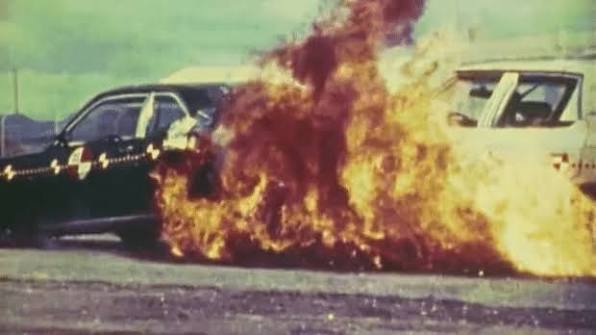
Perhaps the most famous example of a dangerous car, the Ford Pinto wasn’t just deadly, it was explosive! Ha! I love that story, it’s so fun… right?
Not really, no. In fact there’s a very dark side to the flaming Pinto saga. Yes, infamously, the Pinto’s fuel tank would rupture in a rear-end collision over about 25mph, igniting the petrol inside and turning an otherwise low-speed crash into a massive fireball, but the more important part of the story was what was going on behind the scenes. You see, this wasn’t just a small, unintended design quirk. Ford crash tested the Pinto extensively before it went on sale, and in six of the eight of the simulated rear-end collisions, the fuel tank ruptured. Ford’s engineers went back to the drawing board and devised a rubber baffle to sit between the tank and the rear diff housing, cocooning the tank in the event of a crash, but the fix would have added $11 to the production cost of each and every car to roll out of the factory. The only thing stopping them? Lee Iaccoca, president of the Ford Motor company and a ruthless businessman. Iaccoca was adamant that the Pinto cost no more than $2000, safety be damned, and the Pinto was rushed into production to combat the incoming invasion of cheap, economical Japanese and German cars into North America. Shockingly, the fuel tank issue wasn’t even the only reason a Pinto could detonate. Leaky seals meant that petrol vapour would seep out of the block and accumulate under the bonnet, where a single spark would send the car to kingdom come. On top of that, the throttle could stick open, leading to unintended acceleration under certain conditions.
When the press discovered internal memos that showed Ford knew about the issues but did nothing to mitigate them, there was uproar. The memos showed that the company had worked out that it was cheaper for them to settle the potential lawsuits than it would be to implement the proper fix. In an equally ghoulish turn, Ford then voluntarily recalled all 1.5 million Pintos, at a cost of $45 million. By Ford’s own maths, properly addressing the fuel tank issue would have cost them $121 million, so I suppose the accountants still won in the end. An investigation carried out by Ford claimed that only 27 fatalities had been caused by faulty Pintos. Independent investigations found that the number was actually closer to 500, with countless more injured. While the Pinto quickly became a punchline of history, the world seemed to forget that sometimes corporations are willing to do monstrously evil things just to keep their shareholders happy, and a human life is often less valuable to them than the bottom line.


Leave a Reply