Jaguar is not a particularly big car company, not by global standards anyway. It’s always been a bit of an open secret that, since the JLR merger, Jag have been financially propped up by the offroad lads. Don’t believe me? Well, in 2023, they sold around 67,000 full-size Range Rovers, whereas Jaguar could only shift just over 64,000 cars across its ENTIRE model range. Even their big unit-shifter; the F-Pace, was outsold by every Land Rover product except the skew-arsed Discovery. Were it not for Chelsea tractors, Jaguar would have gone bump a long time ago. One the one hand, this might seem like the death rattle of a long-outdated company that we only really keep around for the sake of nostalgia, but for Jaguar, it seems like it might actually be quite liberating. If they aren’t really expected to compete with their German or Japanese rivals on the fleet car spreadsheets, then why not focus on building something more niche. This seemed to be the case in 2018 when, bold as brass, Jaguar pulled the covers off of the most baffling business decision in recent history.
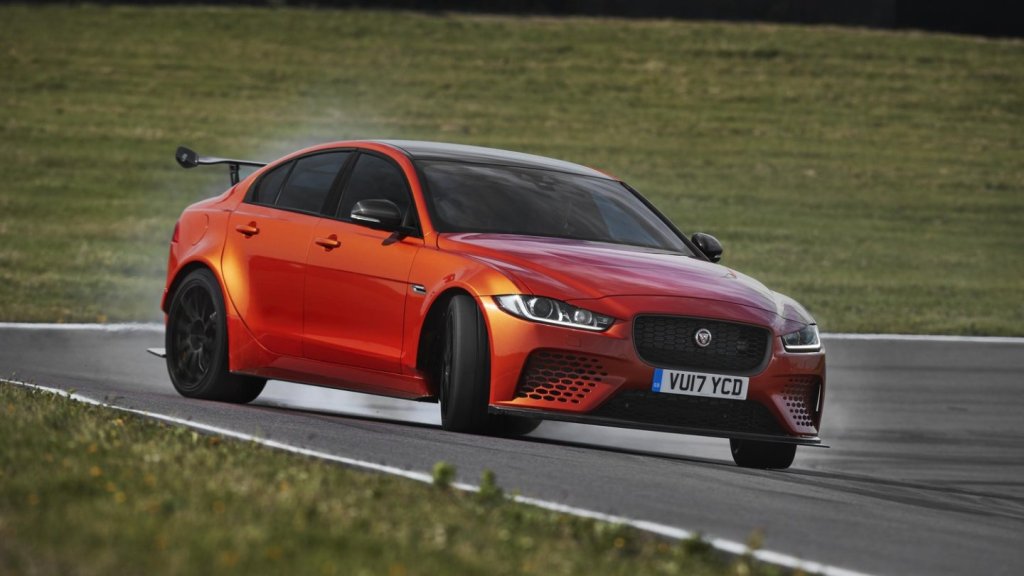
In 2016, Jaguar boss Dr. Ralf Speth wanted a new halo car to market their forthcoming 3-Series competitor the XE. How did BMW usually do it? Well, every version of the 3-Series was usually punctuated by the arrival of an M3, a low-volume, high-performance poster car to make the regular rep-mobile models seem cooler by association. That seemed to be the way forward, so Dr. Speth gave the nod to SVO to come up with Jaguar’s own M3. SVO were no strangers to requests like this, being responsible for all of JLR’s few-off projects over the years. There was the hardcore offroad Discovery SVX, the ultra-luxury Range Rover SVAutobiography, the 200mph F-Type SVR, and the bespoke D-Type throwback F-Type Project 7. With their new saloon-shaped conundrum on the table, SVO set to work fettling. Luckily, the base XE was a surprisingly solid start point, being not only lighter than the regular 3-Series, but faster and sharper to drive as well, but not quite fast enough to go toe-to-toe with BMW’s finest. While the M3’s twin-turbo straight-six made 430 horsepower, the biggest engine in the XE – the supercharged 3.0 litre V6 from the F-Type – made just 340 horsepower, but SVO had a plan.
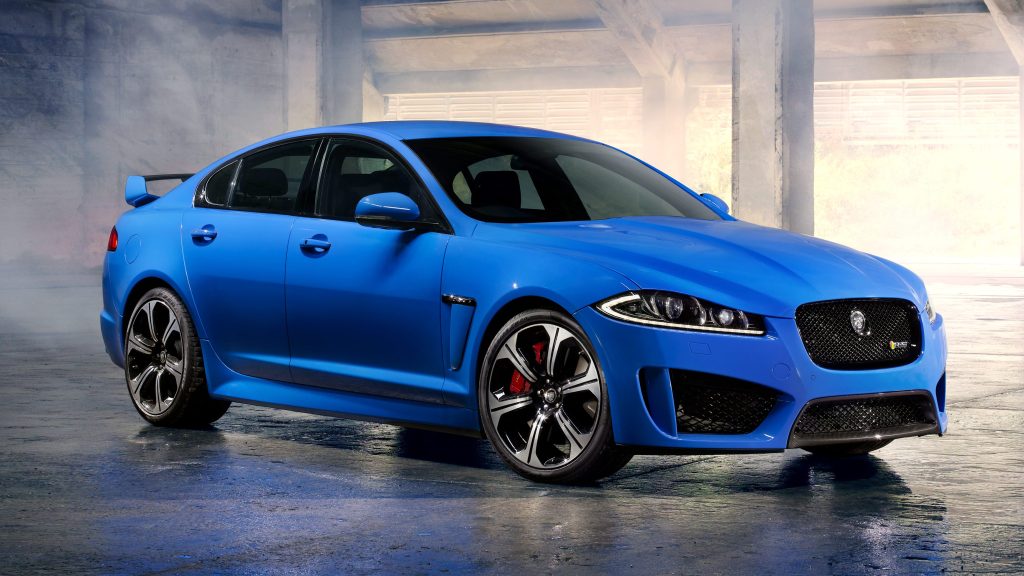
You see, Jaguar had a reputation for V8 muscle cars, with the XJR and XFR both sporting lairy supercharged V8s, and the sharpened track-focused XFR-S marrying it’s 542 horsepower V8 to a tauter, better-balanced chassis. Because of that, no mere four or six-pot would do for Jaguar’s ultimate super saloon, it had to have their signature 5.0 litre supercharged V8, pushed to it’s absolute limits at 600 horsepower. Luckily, SVO was in the throes of building the F-Pace SVR, a hot rod SUV adapted to fit that very same V8, so the F-Pace’s front subframe was pinched and wedged under the bonnet of the saloon. There was only a couple of tiny, almost insignificant little issues. It wouldn’t fit, and it wouldn’t stop. The XE was never designed to fit a V8, so in order to physically get the much larger engine between the front wheels, the steering rack had to be moved, meaning that the V8 XE could only ever be sold as left-hand-drive. Not ideal for a car whose target market was the UK. Even less ideal was the fact that the XE’s standard steel brakes couldn’t handle the enormous power of the new engine, so the car was virtually impossible to stop. Good news! Jaguar had developed a set of Carbon Ceramic brakes to use on the F-Type! Bad news. Those carbon brakes wouldn’t fit under the XE’s wheels, so larger ones would need to be fitted.
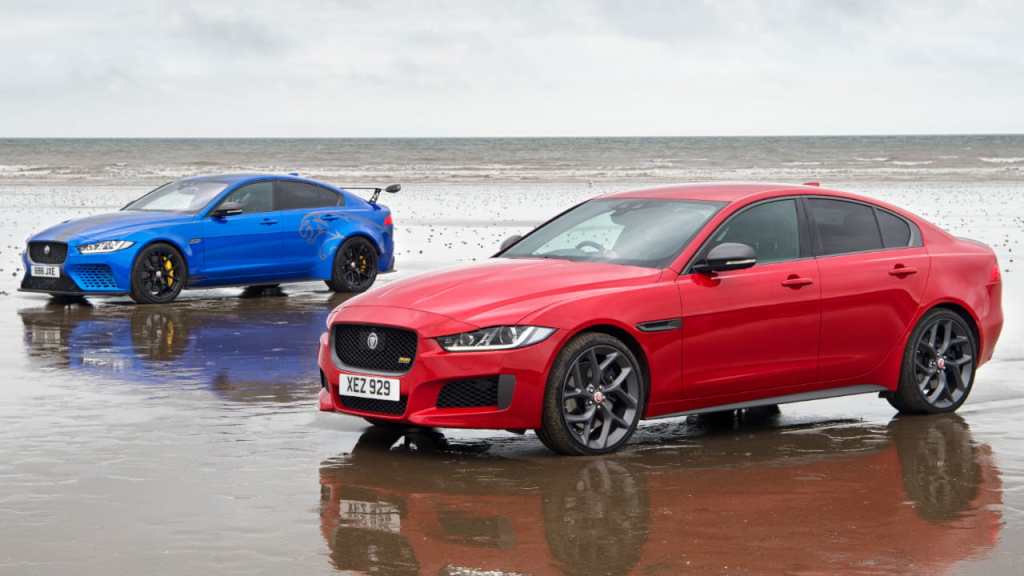
There’s a term in project management called “scope creep”. Essentially, a project grows in scale gradually until you step back one day and realise that the finished product is completely different to what you set out to build in the first place. The XE needs bigger brakes, so it needs bigger wheels, so it needs widened bodywork to accommodate them. The wider wheels get stickier tyres, so the differentials will have to be changed. The V8 power means that the XE could get up toward 200mph, so extra aero is probably a good idea. Extra aero means that new suspension is a must to cope with the downforce. So now it’s a track car, I suppose? Well in that case, it’ll need a larger intercooler so the entire front end will need to be redesigned, and while I’m thinking about it, we’ve got those magnesium bucket seats… You get the idea. By the time it finished development, the Jaguar XE SV Project 8 (to give it it’s full government name) was a stripped out, hardcore, left-hand-drive only, be-winged track-day car, only sharing the front doors and roof panel with the regular XE and nowhere close to the M3 rival it was originally envisioned as. And the price reflected that. Where a BMW M3 would set you back about £60,000, the Project 8 sat in showrooms with a price tag of £150,000. Ah. To try and make the car seem collectable, Jaguar limited production to just 300… and they couldn’t even sell all of them. But that didn’t matter.
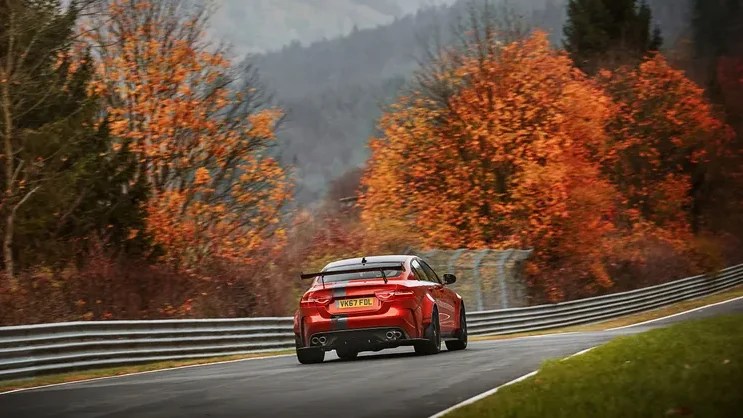
In late November 2017, Jaguar’s development team rocked up the Nürburgring. It was the last day of the season before the ‘Ring was closed for winter, so nobody expected wonders, if anything this would be a final shakedown session to sign off the car for production. Vincent Radermecker slipped behind the wheel and set off to exercise the car’s capabilities, using the aero to balance the car through the faster sections, and the four-wheel-drive grip to fire the car out of low-speed turns, all the while flexing those supercharged V8 muscles. Less than an hour before the track shut up shop, the news came back: The Project 8 had lapped in just 7 minutes 21 seconds, 11 seconds faster than Alfa Romeo’s Ferrari-engined Giulia Quadrofoglio, making it the fastest four-door production car on the planet. Mercedes kicked up a fuss, claiming that since the Jag was still pre-production, the record shouldn’t count, and that their GT63 AMG was, in fact, the fastest at 7 minutes 25 seconds. In response, Jaguar went back to the ‘Ring with a full production Project 8 and clocked in a blistering 7 minute 18 second lap. If ever there were such thing as an automotive mic-drop.
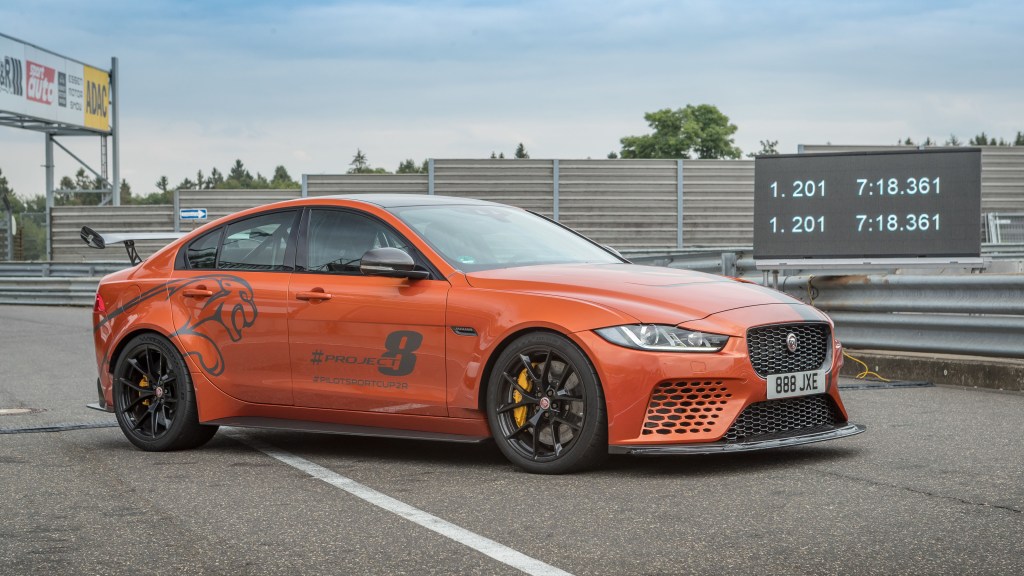
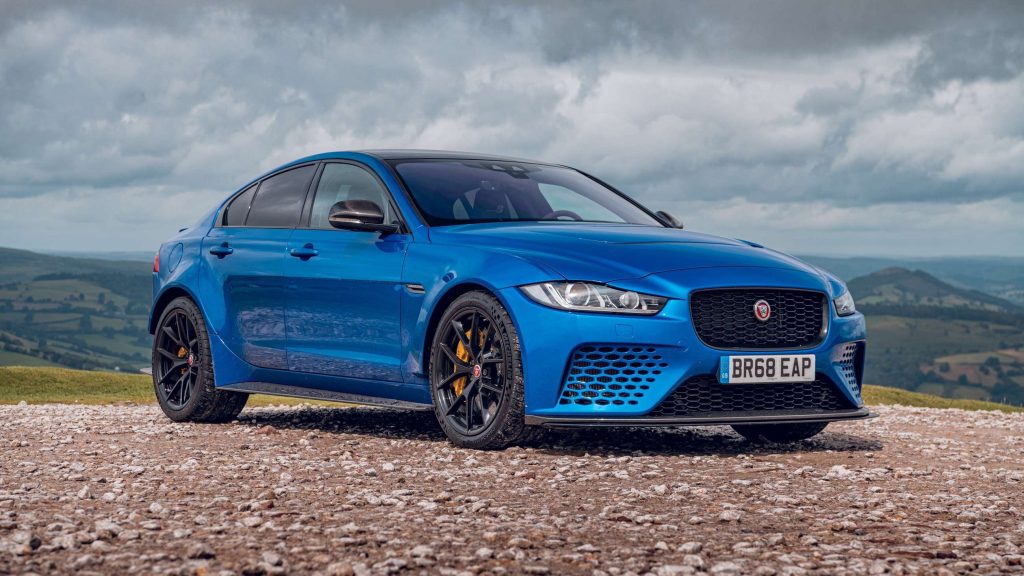
Nowadays, the Project 8 is seen as a modern classic. The last hurrah for the combustion-engined performance car, but at the time, it was basically a folly. The sort of car a skunkworks team might build for a laugh, not the sort of thing that ever gets to see the light of day. I can’t pretend I don’t want one quite badly though. I’ll take mine in dark-blue touring spec please.


Leave a Reply