
The day before this column was published, Aston Martin pulled the covers off their latest supercar, the 840 horsepower Vanq… no, that’s not it… Valour? Victor? Vulcan?… No, not that one… Valen! That’s the one. The Aston Martin Valen (I think Aston are running out of V-words). Anyway, with a twin-turbo V12 roaring away under the bonnet, it’s easy to classify the new brute as a full-on supercar, but where did it all begin? And how did Aston Martin build Britain’s first ever supercar?

It all started in the 1950s, when Aston Martin’s contemporary GT car – the DB2 – was bumped up from 100 horsepower to 125 horsepower with bigger carbs and a higher compression ratio. This new set of factory-fit power teaks became known as “Vantage Specification”, as it gave the owner a superior car to every other DB2 on the roads. This specification carried through to the 1960s, with the DB4, DB5 and DB6 all being offered with the optional Vantage pack for extra power, but it wasn’t until the 1970s when tuning parts began to develop into a whole new car.

In 1966, Aston intended to kill off the DB6 and replace it with an all-new car. Commissioning Touring Superleggera of Milan – designers of the DB5 and DB6 – to draw up the new car, Aston set about working on the underpinnings of the car they decided to call DBS, only for Touring to promptly go bankrupt. Hastily cobbling together a new design, Aston found that they’d rather quickly run out of money to do anything else, and resorted to throwing the new DBS’ angular, square-jawed body over an old DB6 chassis, complete with the antique 4.0 straight-six that Aston had been developing since 1958. By 1972, the DBS had been dropped from the range entirely, with Aston Martin able to go back to the drawing board and build the DB6 replacement they’d wanted in the first place. With a muscle car silhouette, luxury interior and four-seat practicality, the cherry on top of the new car would be it’s all-new engine. Finally ditching the old straight-six, Aston asked their legendary engine man – Polish-born engineer Tadek Marek – to go wild and design the perfect engine to future-proof the car for decades to come. Taking the V8 he’d developed for the Lola T70 Le Mans car, Marek beefed up the block and cylinder head, bored it out to 5.3 litres and fitted fuel injection, slotting the new 345 horsepower heart under the bonnet of the new AMV8.

Not the Vantage yet then? Not quite, that came a touch later. As the Marek V8 was both race-proven and built like a bank vault, it didn’t take long before people started pushing the power even further, with Aston Martin themselves offering the car with bigger carburettors, more aggressive cams and a larger inlet valve to boost power to nearly 400 horsepower. Right, NOW it’s the Vantage. The newly christened Aston Martin V8 Vantage was easily the fastest car Britain had ever built at the time, and could go toe-to-toe with contemporary European exotica like the Ferrari 512BB, Lamborghini Countach and Porsche 911 Turbo, with Steve Cropley of CAR Magazine writing in their 1984 supercar group test:
“There’s no doubt that the Aston is among the very fastest cars in a straight line. It vies with the Porsche as the fastest accelerating production car sold in Britain; its effortless kick in the back feels even more instant than the Porsche’s when you floor the throttle from a constant 120mph.”

With the new bloodline proven, naturally Aston Martin allowed it to unceremoniously fizzle out. In 1988, the V8 Vantage’s successor arrived in the form of the Virage. Designed to try and bring Aston Martin into the modern era (and to allow the venerable 5.3 litre V8 to comply with even more stringent US emission regulations), the Virage was heavier, floppier, less sporting, and some 100 horsepower down on the old car, making it nearly a full second slower to 60mph, and only capable of hitting 155mph, some 15mph slower than the old car. Quite simply, this would not do. In 1992, Aston Martin unveiled the new Vantage. Now based on the Virage underpinnings but massively modified. So modified in fact, that the only shared panels between the Virage and Vantage were the doors, and the roof. Brakes, suspension, aerodynamics, everything was new underneath, and that didn’t stop once you opened the bonnet. To make up for the emissions strangulation of the V8, Aston decided to furnish the Vantage with a supercharger… and then another one. Yes, this twin-supercharged behemoth (one supercharger for each cylinder bank) turned the anaemic, wheezing Virage into the 550-horsepower Vantage V550, a car capable of hitting 186mph, but it was the torque that really set it apart from its contemporaries, with EVO Magazine’s Dickie Meaden noting:
“This is a seriously fast machine.[…] There’s also something deeply impressive about the sense of energy and physics at work in picking up 1990kg of car and lobbing it down the road with such disdain. For a party piece, select a high gear and go from walking pace to warp speed in one eye-widening, ever-intensifying lunge. It really is like a steam locomotive once it hits its stride”
And there’s more. Not content with ONLY 550 horsepower, the discerning Aston Martin buyer could request something called the V600 pack, boosting the car’s power even further to… you guessed it. In fact, when the McLaren F1 went out of production in 1998, the Vantage V600 was the most powerful production road car on sale anywhere in the world.
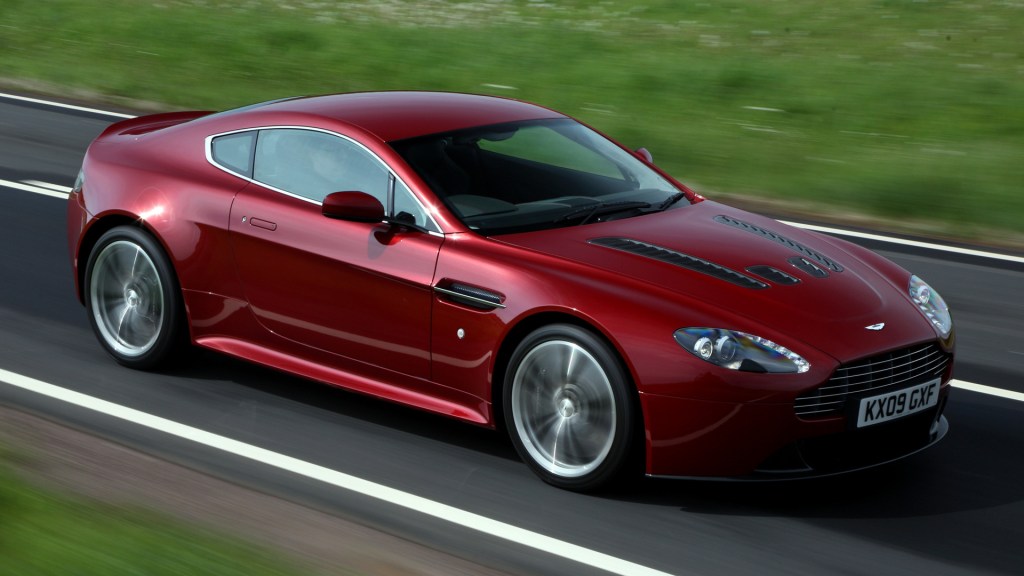
To get us up to speed with the present day then, the next Vantage badge appeared on the DB7 in 1999, introducing a brand-new V12 to Aston Martin’s range, one that would go on to define the brand for the next two decades. The model would return in 2005, with the V8 Vantage now positioning itself as the “baby” Aston, before somebody decided to cram a V12 under the bonnet and created a 200mph hot rod (a car you may know I absolutely ADORE), and in 2018 the Vantage became the first Aston to borrow an engine from the nutters at Mercedes-AMG, slotting the 4.0 litre twin-turbo V8 from the AMG GT S into the Aston’s svelte figure. The current Vantage is a 670-horsepower twin-turbo rocket sled designed to give Ferrari and McLaren a bloody nose while retaining enough luggage space and ride quality to be a car you’d want to cross a continent in. Had I the money and garage space, I’d love to bring together three of the best Vantages. I think between the style and pedigree of the original V8 Vantage, the crushing performance of the Vantage V600, and the skunkworks cool factor of an original V12 Vantage, you could end up with one of the greatest automotive bloodlines Britain – or indeed the world – has ever produced.


Leave a Reply