There’s a process in motorsport called ‘homologation’, where road cars are turned into racers. Want to build a rally car out of your normal family hatchback? Well, you build a Ford Escort with a massive turbo engine and four-wheel drive, call it the Escort RS Cosworth and then hand that to the rally boys to use for competitions. The same goes for circuit racing, with Ferrari F40s, Porsche 911s and McLaren F1s all being adapted for the track, creating some of the coolest versions of their respective models in the process. We’ve seen what happens when you homologate a road car for racing, but what happens if you take a race car and try to sanitise it for the road?
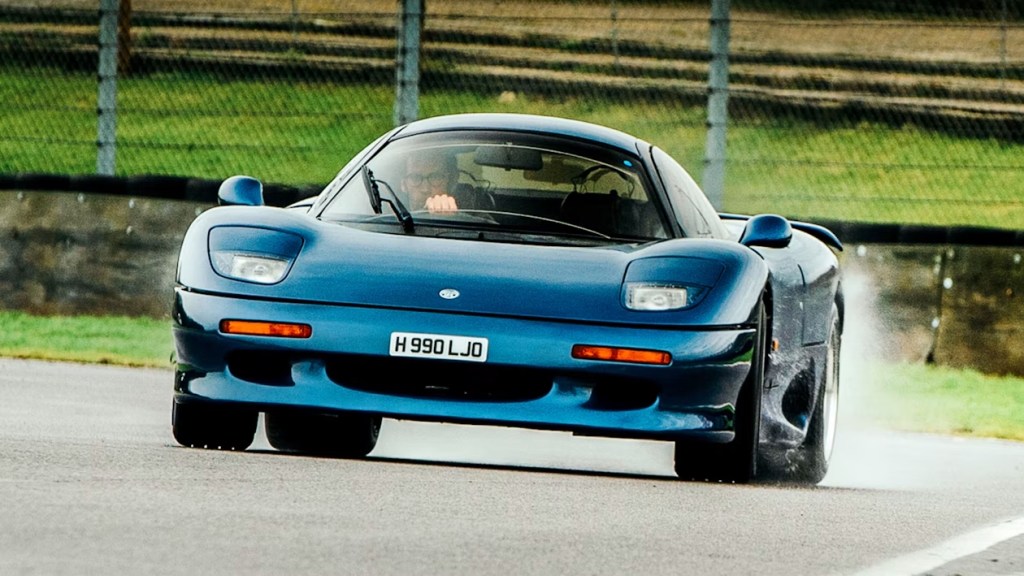
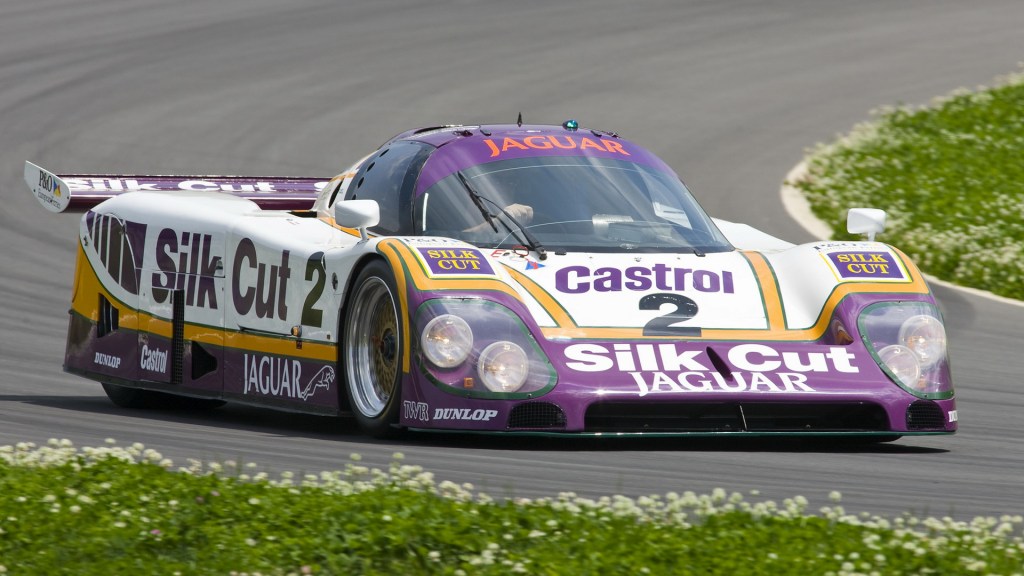
We begin with our old mate Tom Walkinshaw, watching the Jaguar stand at the 1988 Birmingham Motor Show. On said stand is Jag’s new world-beating hypercar – the XJ220 – and it’s given Walkinshaw an idea. You see, the XJ220 concept was a mid-engined V12 monster, and Walkinshaw himself had spent that previous June racing his own mid-engined V12 Jaguar to victory at that year’s Le Mans 24hr race, so what if he could beat Jaguar at their own game? Well, he already had his own little side business under the JaguarSport name, so the first thing Walkinshaw did was bring in the racing car for a thorough going-over. The Jaguar XJR-9 was an absolute track weapon, with its ground-hugging bodywork and 7.0 litre V12 powerplant making it the only car able to break Porsche’s 8-year Le Mans winning streak. A road car however, it was not. The nose was so low that you’d scrape it if you tried to drive over a pancake, the noise was so deafening that you’d burst the eardrums of anyone in a three-mile radius if you drove it through town, and the enormously thirsty V12 meant that you wouldn’t be driving past many petrol stations.
Firstly, Walkinshaw hired car design guru Peter Stevens to sketch up a new body for the road car. Now, Peter Stevens is a name you might not know, but I bet you’ll recognise his work, given his name was on cars like the Rover 75, Lotus Esprit, MG TF, and one of my all-time dream cars; the Subaru Impreza P1. In fact, immediately after the XJR-15, he’d go on to co-design the McLaren F1 with Gordon Murray. Stevens got to work making the car liveable, widening the cockpit, raising the roofline, and increasing the size of the door aperture, meaning that actual humans could fit inside it, while the engineering team fixed the issue of the enormous thirst. The 7.0 litre racing V12 was removed, replaced with a heavily tuned version of the 6.0 V12 from the Jaguar XJS, dropping the power from 750 horsepower to a more manageable 450 horsepower, and to keep the performance competitive, the car was considerably lightened, with Stevens’ bodywork being constructed entirely out of a carbon-fibre Kevlar composite, a world-first for any road car, which meant that, even with an enormous V12 on board, the car only tipped the scales at just over a tonne, 200kg lighter than the comparable Ferrari F40. Meanwhile, the XJR-9’s suspension and chassis came over almost wholesale, only being given a slightly taller ride height and softer suspension to deal with day-to-day bumps.
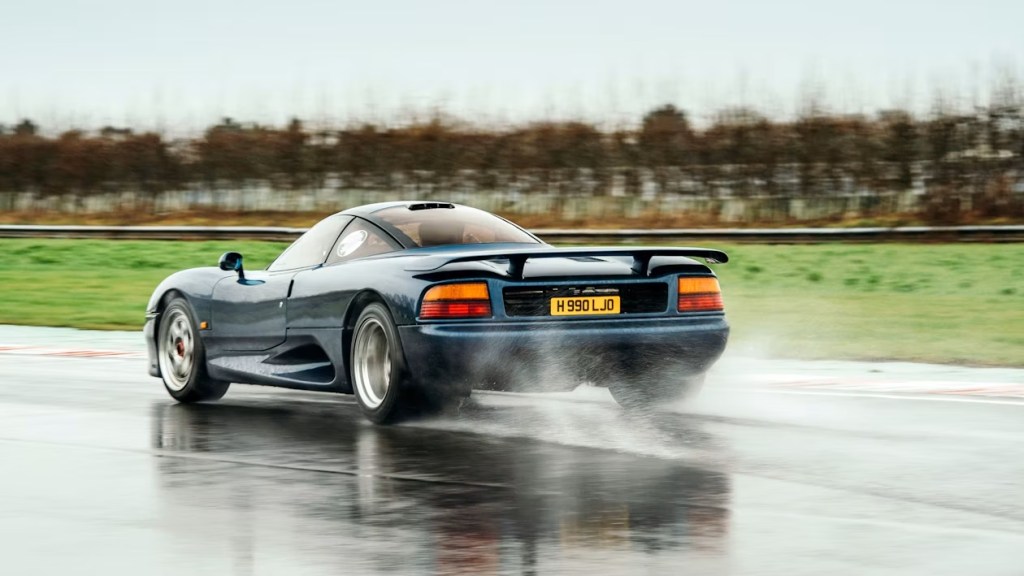
The result was a road car with a noticeably harder edge that most of the contemporary crop of supercars. Unlike a Lamborghini Diablo, the XJR-15 was no poser, with its sleek, swooping bodywork designed to work the air rather than draw the eye. While closer in philosophy to the stripped-out Ferrari F40, the concession to a huge V12 rather than a smaller, lighter, more power-efficient turbo engine seemed like an odd choice, but it gave the car a true racetrack reject character, with the DNA of its Le Mans lineage on overt display to anyone behind the wheel. Even compared to Jaguar’s own XJ220, the XJR-15 felt like a pure track tool, almost entire sans creature comforts, where the XJ220 could cruise down to Spa-Francorchamps in comfort, the XJR-15 was designed to go around it at full pelt. the As summed up by Henry Catchpole for EVO magazine when he revisited the car in 2022;
“Feedback through the steering really is good, and although there is more roll than in an [Ferrari] F40, there is much less than in a McLaren F1 […] The engine too, although gruff and palpably potent […] is also responsive and easy to manage thanks to being naturally aspirated. As such the whole driving experience feels more encouraging than it’s reputation had led me to believe”
Ah, now, that “reputation”. Here is where the XJR-15 story starts to fall apart a little.
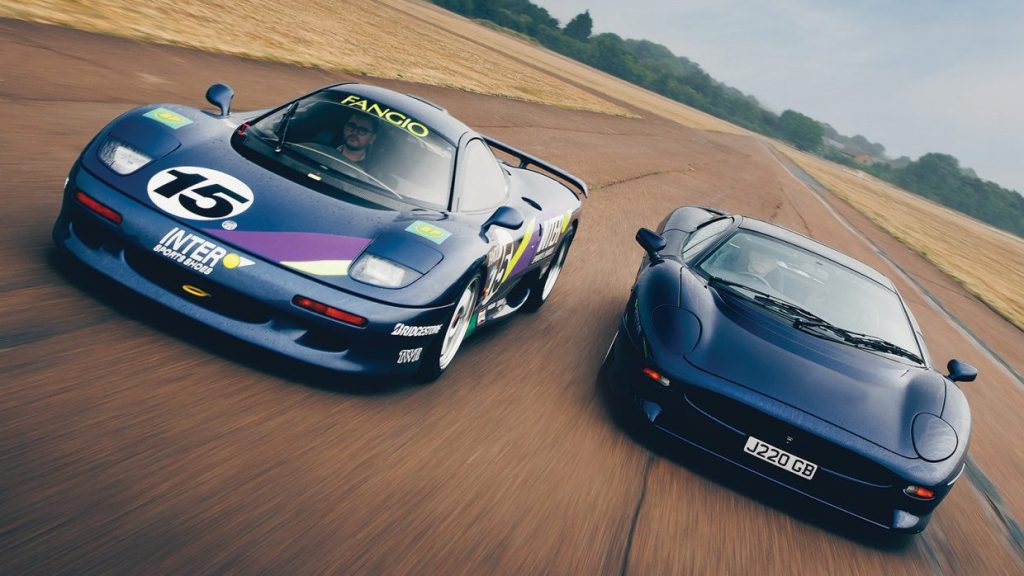
In order to get the car to live up to its “road racer” ethos, the XJR-15 needed to go racing. Unfortunately, all the alterations made to the racing car underpinnings meant that the XJR-15 no longer complied with any racing regulations, so it couldn’t join the track action… or so it seemed. If the Jag didn’t meet the criteria for any existing races, then Walkinshaw would simply have to make own race series. In 1991, the world was introduced to the Jaguar Sport Intercontinental Challenge, a one-make race series that would act as a support event. That means that during the Formula 1 race weekends at Monaco, Silverstone and Spa, before Messrs Senna, Mansell, Shumacher, Häkkinen, Alesi and Prost got into their F1 cars, the XJR-15s would be deployed for a few laps to warm the tarmac up. Because the cars were being sold at a million-quid-a-pop, most of the privateer teams hired professionals to take part on their behalf, with names like Tiff Needell, Armin Hahne, David Brabham and Jauan Manuel Fangio(‘s nephew) getting behind the wheel of the grid full of brand-spanking-new hyper-Jags in hopes of winning a $1 Million grand prize. And this is where the problems began. In order to get the racing XJR-15s to qualify, Walkinshaw had scrapped the Goodyear road tyres for some proper racing slicks, but Bridgestone – the tyre supplier for the race – didn’t have anything that would fit the XJR-15s enormous rear wheels, so they had to sub in the narrower tyres from the Ferrari F40 racing car, and that meant that the Jags had much less rear-end grip than they should have, with Needell recalling that every race involved armfuls of oversteer, and even having to apply opposite-lock in the famous Monaco tunnel (which is taken flat in most every other racing car).
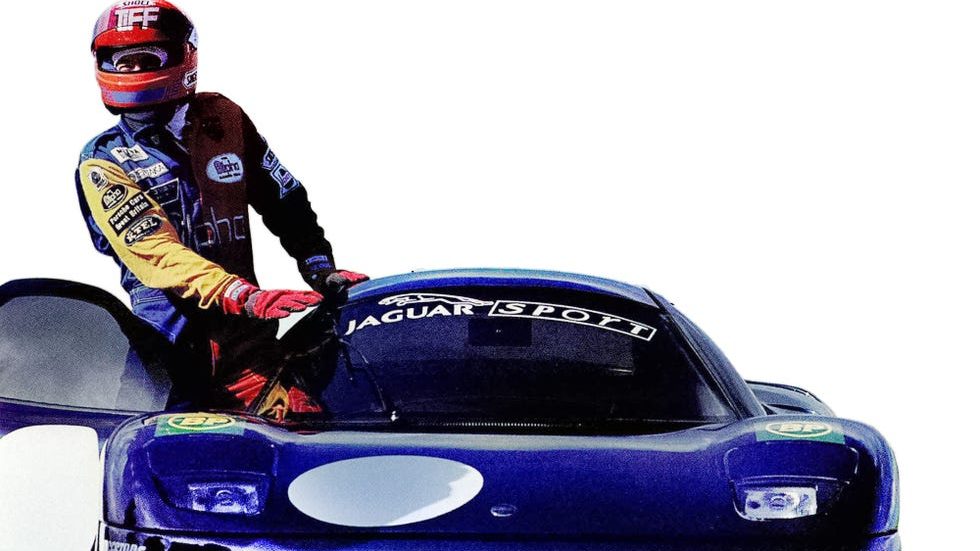
Had the XJR-15 remained only a road car, it possible that more people would have known it as the razor-sharp handling machine that it was designed to be, but as the support races were supposed to be the big unveiling, with the eyes of the world watching professional racers struggling to complete lap after lap without the spikey, under-tyred psycho Jag spinning off into the Armco, the XJR-15 was, like many, relegated to the history books as a car that seemed like a good idea at the time.


Leave a Reply