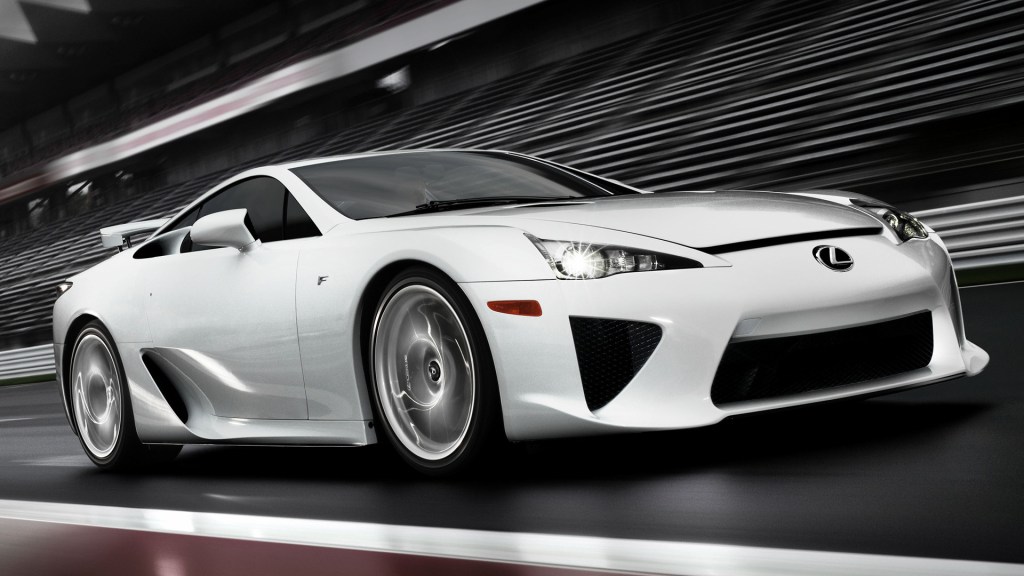
I’ve spoken before about how Japanese cars don’t really light my fire. For me, ultimate efficiency is nowhere near as fun as character, even at the expense of being a little rough around the edges. I must, however, bend the knee to one particular car. A God among mere machines. The passion project of one of the most powerful men in the world. Not just the greatest Japanese car, but one of the single greatest road cars of all time: The Lexus LFA.
2000.
Akio Toyoda approaches the board of the Toyota corporation. Founded by his grandfather some 63 years earlier, Toyota is now the largest automobile manufacturer in the world, and Akio-San’s family name is adorning a skyscraper at the centre of Toyota city, an entire three-hundred-and-fifty square mile section of the Chūbu region of Japan dedicated to churning out his company’s cars. He’s been given a proposal by his friend, Toyota’s chief test driver Hiromu Naruse, for a car that could cement Toyota’s legacy among the world’s greatest marques. Not just a common-or-garden sports car like other Japanese car makers had been building all through the nineties, but a genuine world-beating supercar. There’s only one small problem. Akio’s name might be above the door, but he isn’t actually the chairman… yet… and the project still needs the go-ahead from the higher-ups. Showcasing his unique way with words, Akio manages to convince the board with tales of the famous histories of Ferrari, Lamborghini and Aston Martin, promising to them that Toyota will one day be considered at the same level.
2005.
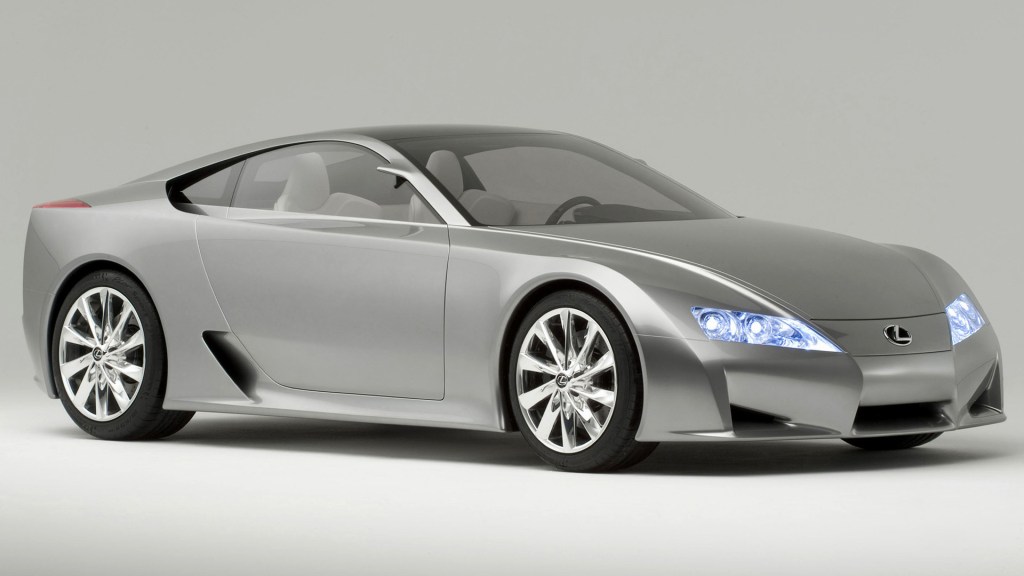
January. Detroit, Michigan. The North American Auto Show. The covers come off Toyota’s little secret for the first time. Deciding that a car with a supercar price tag is probably a bit of a jump for regular Toyota punters, the car now carries a new badge, that of Toyota’s luxury sub-brand, Lexus, and a new name: LF-A. A small front-engine two-seater coupe, the LF-A boasted an all-aluminium construction, making it lighter and stiffer than many of it’s rivals. Reception was excellent, and Toyota management gave the greenlight to resume development in earnest.
2007.
The LF-A’s power-to-weight ratio simply isn’t good enough. The entire project is scrapped and sent back to the drawing board. Beginning again from the ground up, the decision is made to build the LF-A with a state-of-the-art carbon fibre tub chassis. In developing the car, Toyota starts to siphon personnel and resources from their own Formula One efforts, and rumours begin to spread that the new car will feature a racing-derived V10.
2008.
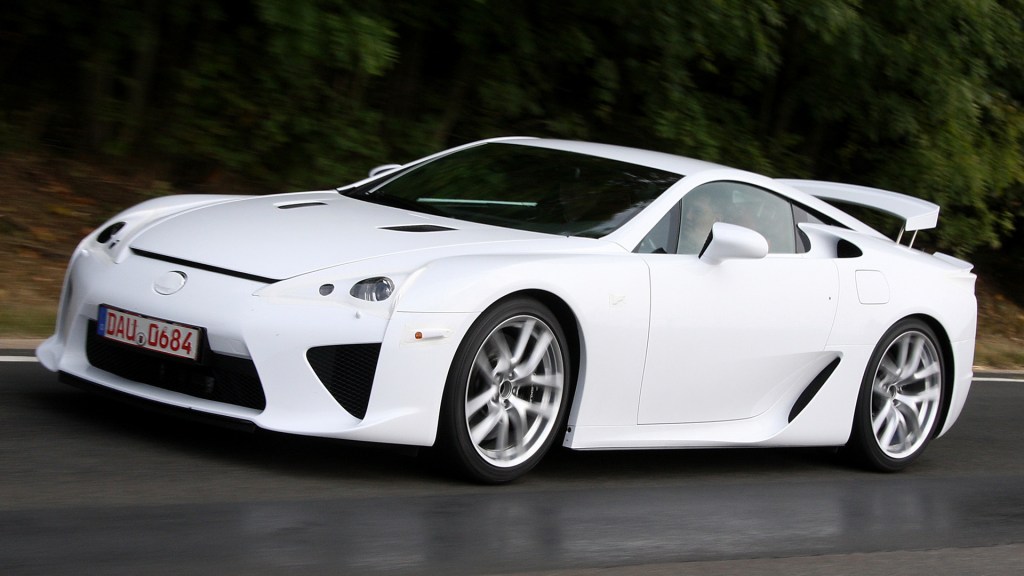
Disguised test cars are spotted hurtling around the Nürburgring, one of them is even a convertible. The United States patent office reveals that Toyota has just trademarked the name “LFA” (now sans hyphen).
2009.
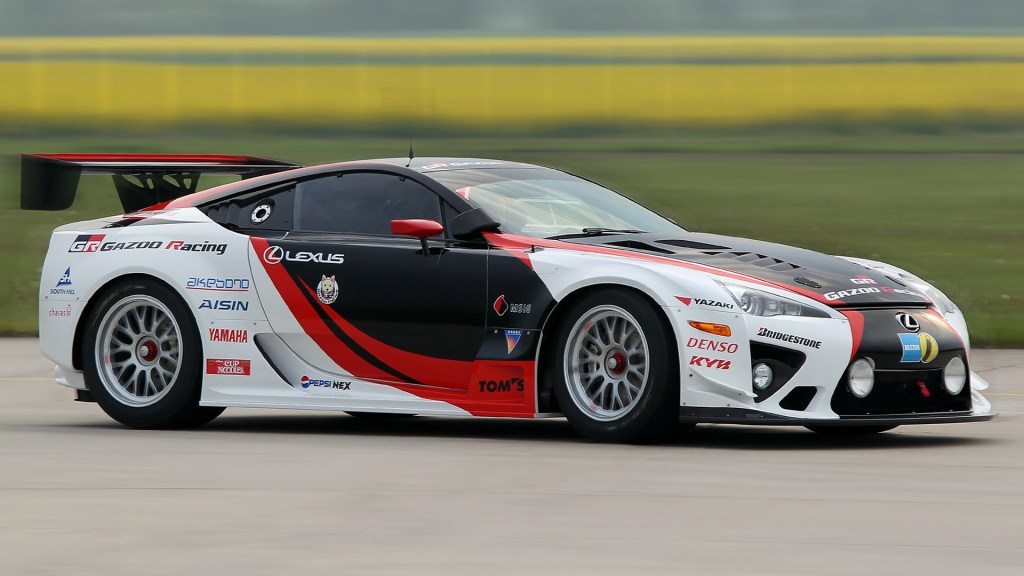
Akio Toyoda stands in front of the world’s press as Toyota’s newest CEO. Now the man in charge, he sees fit to finally break the secret. The LFA project is real. The production cars will have V10 engines and what’s more, the LFA will be competing in the upcoming Nürburgring 24hr race. And he’d know. Piloting the LFA for one of its four-hour stints was an unknown racing driver that nobody recognised. Some say the chap’s name was Morizo Kinoshita and, for some reason, he never seemed to remove his helmet. That’s right, realising that taking time out of his week to fly halfway around the world to drive fast cars would probably land him in trouble with Toyota’s boardroom, Akio-San pulled his best The Stig impression and raced under a pseudonym, finishing fourth in class.
2010.
After an entire decade of development, re-development, endurance racing and fake names, the LFAs finally begin to roll off of the production line. Boasting a 553bhp, 4.8 litre V10, a 1.4 tonne kerb weight, a 3.6 second 0-60 time and a 202mph top speed, the LFA instantly plants itself among the highest echelon of supercars, going toe-to-toe against the likes of the Lamborghini Gallardo, Ferrari 458 and Aston Martin DBS. The car’s exhaust was acoustically tuned by Yamaha’s musical instrument department to make it one of the most symphonic noises ever to erupt from a road car. There’s simply nothing like it, nothing built before or since has managed to match the audible perfection of the LFA’s sound profile. Seriously, close this page and go and look it up on YouTube, I’ll wait. Done? Excellent. With the power, the lightness and the noise all sorted, you’d imagine the LFA would be a slam-dunk success for Toyota then, right? Well, there’s one small problem. Because Toyota’s best and brightest had spent the best part of a decade pushing the boundaries of technology and building bespoke parts using cutting edge materials, the price had to reflect that. While a similarly powerful Aston Martin DBS would set you back a whopping £180,000, the Lexus was an eye-watering £340,000, and for double the price of it’s priciest rival, it became almost impossible for buyers to justify. Just 38 LFAs would find their homes in Europe, and even a decade on from its launch (as of 2020) four LFAs remained unsold on dealership forecourts.
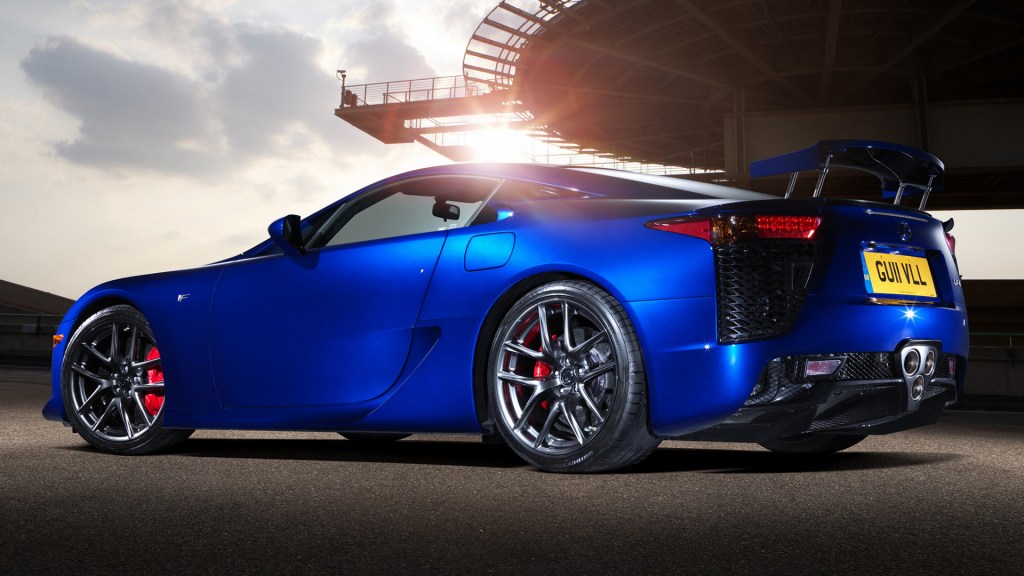
A failure then? No, far from it. The LFA proved that Toyota could take on Europe’s finest at their own game, building one of the finest bedroom-wall poster cars of all time. With a sound to wake the Gods, looks that leave you slack-jawed in astonishment and performance figures to leave your eyeballs pushed to the back of your skull, the LFA is not just a car, it’s an icon.

 Project Petrolhead
Leave a reply to Simon Cancel reply